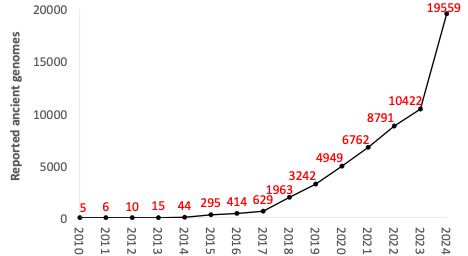
Reconstructing human population history: Ancient DNA allows us to go beyond the two-dimensional understanding of human genetic variation based on the coordinates of latitude and longitude, and to develop a three-dimensional understanding adding the coordinate of time. We are developing statistical methods and working with archaeologists and local stakeholders to study ancient peoples and cultures from across the world to answer questions about our shared past. So far about 70% of data is from West Eurasia where there is a nearly gapless record in space and time. It is of great interest to carry out similar studies everywhere humans have lived.
Leveraging ancient DNA to understand adaptation: Ancient DNA has already been a runaway success in improving our understanding of population movements and mixtures. But until recently there has been little progress in shedding light on how the forces of natural selection have shaped human traits over time, because what is required for this is the ability to track the frequencies of mutations over time which requires large sample sizes. We have focused on generating the large datasets and analyses needed to make such studies possible.
Leveraging history to obtain insight into disease: The more we learn about human populations, past and present, the more we can apply this knowledge to address practical needs such as targeting medical services to people who need it. A focus of our lab has been to document endogamous groups in India that have experienced population bottlenecks. This predicts many rare recessive diseases in India, which can be tested for using modern genetic methods.